
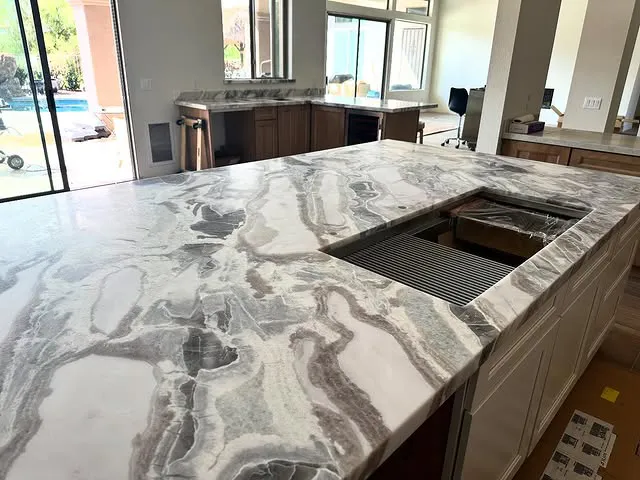
Granite Slabs: Prices, Selection, and What to Expect in Las Vegas
Granite slabs offer Las Vegas homeowners a durable and elegant solution for kitchen and bathroom countertops, but understanding the costs and selection process is essential before making this investment. In Las Vegas, granite slab prices typically range from $40 to $200+ per square foot depending on the grade and rarity of the stone, with installation adding another $35 to $70 per square foot to your total cost. These prices reflect both the material quality and the complexity of your specific project.
Choosing the right granite slab involves more than simply picking a color you like. You need to consider the type and quality of granite, slab thickness, edge profiles, and how these factors align with your budget and design goals. The Las Vegas market offers access to both locally sourced and exotic imported stones, giving you plenty of options to match your aesthetic preferences.
This guide walks you through everything you need to know about purchasing granite slabs in Las Vegas. You’ll learn how pricing works, what varieties are available, how to select the perfect slab for your space, what the installation process involves, and how to maintain your granite countertops for years to come.
Free Estimate
Get a free estimate for quartz countertops, granite and marble countertops, slab shower walls, and custom stone fabrication in Las Vegas. Our team will review your project, answer your questions, and recommend the best options for your space, style, and budget.
Granite Slab Pricing in Las Vegas
Granite slab prices in Las Vegas range from $40 to $100 per square foot installed, with material costs varying based on grade, thickness, and customization requirements.
Price Ranges by Grade and Type
Granite slabs are categorized into different grades that directly impact your costs. Entry-level granite typically starts at $40-50 per square foot installed, featuring simpler patterns and more common colors. Mid-grade options range from $50-70 per square foot and offer more distinctive veining and color variations. Premium and exotic granite slabs command $70-100+ per square foot, showcasing rare patterns, unique colors, and stones sourced from specific quarries worldwide.
The material itself, when purchased as raw slabs, costs between $5-20 per square foot before fabrication and installation. Granite tiles represent a more budget-friendly option at $5-15 per square foot. These prices reflect the Las Vegas market where multiple fabricators and slab yards maintain extensive inventories, creating competitive pricing for homeowners.
Cost Factors: Thickness, Edges, and Customization
Standard granite slabs come in two thickness options: 2cm (3/4 inch) and 3cm (1 1/4 inch). The 3cm slabs cost approximately 20-30% more but provide added durability and eliminate the need for plywood backing.
Edge profiles significantly affect your total investment. Basic straight or eased edges typically come included in base pricing. Decorative edges like bullnose, ogee, or waterfall designs add $200-300 to your project costs. Complex custom edges or multiple edge treatments increase expenses further.
Common customization costs:
- Cutouts (sink, cooktop): $100-200 per cutout
- Seams: $200-300 per seam
- Backsplash: $40-60 per square foot
- Special finishes: $10-25 per square foot additional
The pattern complexity and color consistency you select also influence pricing. Granite with dramatic veining or rare coloration requires careful slab selection and may generate more waste during fabrication, increasing material costs.
Labor and Installation Expenses
Professional fabrication and installation labor in Las Vegas runs $300-500 for standard projects. This covers template creation, cutting, polishing, and on-site installation. Your total installation package includes materials like adhesives, supports, and sealants, which add $400-600 to the project.
Complex installations involving multiple seams, difficult access, or intricate layouts increase labor costs. Most Las Vegas fabricators charge by the project rather than hourly, with typical complete installations ranging from $2,000-4,000 including materials. Removal of existing countertops adds $200-400 to labor expenses.
Types of Granite Slabs Available
Granite slabs in Las Vegas fall into distinct price tiers based on rarity and origin, while marble, quartzite, and quartz offer alternative materials with different performance characteristics and aesthetic qualities.
Entry-Level, Mid-Grade, and Exotic Granite
Entry-level granite typically costs $40 to $60 per square foot installed. These slabs feature simpler patterns with fewer color variations and come from high-production quarries in China, India, and Brazil. Common options include Santa Cecilia, Uba Tuba, and New Venetian Gold.
Mid-grade granite ranges from $60 to $90 per square foot. You’ll find more distinctive veining patterns and color combinations in this category. Popular choices include Kashmir White, Tan Brown, and Giallo Ornamental, which offer better visual interest without premium pricing.
Exotic granite starts at $90 per square foot and can exceed $200 for rare varieties. These slabs showcase dramatic patterns, vibrant colors, and unique mineral compositions. Options like Blue Bahia, Van Gogh, and Fusion feature bold movements and limited availability from specific quarries. The higher cost reflects both scarcity and the increased labor required for extraction and fabrication.
Marble and Quartzite Alternatives
Marble provides a classic aesthetic with softer veining patterns than granite. However, marble requires more maintenance since it’s porous and prone to etching from acidic substances. Prices range from $75 to $250 per square foot depending on the variety.
Quartzite offers granite-like durability with marble-like appearance. This natural stone forms when sandstone undergoes extreme heat and pressure, creating a harder surface than marble. Quartzite resists scratches and heat better than marble while maintaining elegant veining patterns. Expect to pay $80 to $150 per square foot for quartzite.
Both materials need regular sealing to prevent staining. Quartzite handles daily kitchen use more effectively than marble, making it suitable for high-traffic countertops.
Comparing Granite to Quartz Options
Quartz countertops consist of 90-95% ground natural quartz mixed with resins and pigments. Unlike granite slabs that are quarried as solid pieces, quartz is engineered in factories. This manufacturing process creates consistent patterns across slabs and eliminates the natural variations found in granite.
Quartz doesn’t require sealing and resists staining better than granite. However, it can’t withstand high heat as well, and hot pans may cause discoloration or damage. Quartz typically costs $60 to $120 per square foot installed, overlapping with mid-grade to exotic granite pricing.
Granite maintains its value as a natural stone and handles heat from cooking without damage. Each granite slab is unique, while quartz offers predictable patterns. Your choice depends on whether you prioritize the distinctive character of natural stone or the uniform appearance and lower maintenance of engineered material.
Slab Selection Process
Visiting showrooms in person lets you see the actual stone materials, compare colors and patterns side by side, and work with staff to find slabs that match your project requirements. Quality evaluation comes down to examining the stone’s consistency, checking for structural flaws, and understanding how different finishes affect appearance and maintenance.
Showroom and Warehouse Visits
Las Vegas granite suppliers maintain both indoor showrooms and outdoor slab yards where you can view inventory. Indoor showrooms typically display smaller samples and popular selections in climate-controlled environments with proper lighting. The outdoor warehouse or slab yard is where full-size slabs are stored vertically on racks.
You should plan to visit the warehouse area to see full slabs rather than relying only on small samples. Granite varies significantly from one slab to another, even within the same color family. What you see on a 12-inch sample may look completely different across an 8-foot slab.
Bring photos of your cabinets, flooring, and backsplash when you visit. Natural and artificial lighting affect how granite appears, so ask staff to show slabs in different lighting conditions. Many suppliers can use equipment to lift and display slabs vertically so you can see the full pattern and veining before making your selection.
Choosing Patterns, Colors, and Finishes
Granite slabs come in three main pattern categories: consistent, veined, and speckled. Consistent patterns work well in modern kitchens, while dramatic veining creates focal points in larger spaces. Speckled granite typically contains multiple mineral colors distributed throughout the stone.
Color selection should account for your existing design elements. Light-colored granite like white or beige makes small kitchens appear larger and pairs well with dark cabinets. Darker stones like black or deep brown hide stains better and complement light cabinetry.
The finish you choose affects both appearance and maintenance requirements:
- Polished: High-gloss surface that enhances color depth and requires regular sealing
- Honed: Matte finish that hides water spots and fingerprints but may stain more easily
- Leathered: Textured surface that provides grip and conceals minor scratches
How to Evaluate Slab Quality
Quality granite should have consistent thickness across the entire slab, typically 2 or 3 centimeters. Check for visible cracks, fissures, or pits that could compromise structural integrity. Small fissures are natural characteristics in some granite types, but deep cracks indicate potential problems.
Examine the slab for color consistency, especially if you need multiple slabs for a large project. Request slabs from the same bundle or lot number to ensure they match. Look for any signs of resin filling, which manufacturers use to repair minor imperfections.
Ask about the stone’s origin and mineral composition. Granite from Brazil, Italy, India, and Spain each has distinct characteristics. Harder stones with tight grain patterns resist scratching and etching better than softer, more porous varieties. Request information about absorption rates and recommended sealing schedules for your chosen slab.
Purchasing and Installation Experience
The granite countertop purchasing process in Las Vegas involves obtaining detailed quotes, precise measurements, custom fabrication, and professional installation that typically spans several weeks from start to finish.
Obtaining Quotes and Preliminary Estimates
You should request quotes from multiple fabricators in Las Vegas to compare pricing and services. Most companies offer free consultations where they assess your space and discuss granite selection options. Expect quotes to include the cost per square foot for materials, fabrication fees, and installation labor.
Installation costs in Las Vegas typically range from $35 to $70 per square foot depending on project complexity. Your quote should specify whether it includes services like templating, edge profiling, cutouts for sinks and cooktops, and initial sealing. Ask about additional charges for premium edge profiles like ogee or waterfall edges, as basic eased or beveled edges are usually included in standard pricing.
Request a breakdown that separates material costs from labor charges. This transparency helps you understand where your money goes and makes it easier to compare quotes across different providers.
Accurate Measurement and Fabrication Steps
Professional templating occurs after you finalize your granite selection. A technician visits your home to create precise measurements using physical templates or digital laser measuring tools. This step happens only after cabinet installation is complete to ensure accuracy.
The fabrication process begins once you approve the template. Fabricators cut your granite slabs to exact specifications, create cutouts for fixtures, and finish the edges according to your chosen profile. This phase typically takes 7-14 days depending on the fabricator’s workload and your project’s complexity.
You may have the opportunity to visit the fabrication shop to inspect your slabs before cutting begins. This allows you to verify the stone’s pattern and color match your expectations.
Professional Installation Timeline
Granite countertop installation in Las Vegas usually takes one to two days for an average-sized kitchen. The installer removes your existing countertops (if applicable), prepares the cabinet surfaces, and carefully positions the new granite slabs. They apply adhesive, secure the pieces, and complete all seam work.
The team will create cutouts for sinks and cooktops if these weren’t pre-cut during fabrication. They also apply initial sealing to protect the porous stone from staining. You should avoid using your new countertops for at least 24 hours after installation to allow adhesives and sealant to cure properly.
Your installer should clean the work area and remove all debris before completing the job. Schedule your installation when you can stay home to address any questions or concerns that arise during the process.
Long-Term Care and Maintenance of Granite Slabs
Granite countertops require regular sealing to prevent stains and routine cleaning with appropriate products to maintain their appearance and durability over time.
Sealing and Protecting Granite Surfaces
Granite is a porous natural stone that needs periodic sealing to prevent moisture, oils, and stains from penetrating the surface. Most granite countertops require resealing every 1-2 years, though the frequency depends on usage patterns and the specific type of granite you have.
You can test whether your granite needs sealing by placing a few drops of water on the surface. If the water absorbs within a few minutes, it’s time to reseal. The sealing process is straightforward and can be done yourself using granite-specific sealers available at home improvement stores.
Apply the sealer evenly across the surface, let it penetrate for the recommended time (typically 15-20 minutes), then wipe away any excess. This protective barrier significantly reduces the risk of permanent staining and helps maintain the stone’s natural beauty. Proper sealing also makes daily cleaning easier by preventing liquids from soaking into the stone.
Routine Cleaning and Stain Prevention
Clean your granite countertops daily with a soft cloth and pH-neutral cleaner designed for natural stone. Never use acidic cleaners like vinegar, lemon juice, or bleach, as these can break down the sealant and damage the stone surface.
Wipe up spills immediately, especially liquids like wine, coffee, juice, and cooking oils. Even sealed granite can stain if acidic or pigmented liquids sit on the surface for extended periods. For daily maintenance, warm water and mild dish soap work well for most cleaning needs.
Avoid abrasive scrubbing pads or harsh cleaning tools that can scratch the surface. Use trivets or heat-resistant pads under hot pots and pans, even though granite has high heat resistance. For stubborn stains, create a paste with baking soda and water, apply it to the affected area, let it sit for several hours, then gently wipe clean.
Frequently Asked Questions
Granite slab pricing in Las Vegas ranges from $40 to $200+ per square foot depending on grade and origin, with most projects priced by square foot installed rather than by whole slabs. Inspecting color consistency, natural fissures, and finish quality before purchase helps ensure you get exactly what you expect.
What is the typical price range for granite slabs in Las Vegas?
Granite slabs in Las Vegas typically range from $40 to $200+ per square foot for the material alone. Entry-level granite starts around $40 to $60 per square foot, mid-range options fall between $70 and $100 per square foot, and premium or exotic varieties can reach $100 to $200+ per square foot.
The total installed cost includes fabrication and installation labor. Entry-level granite projects typically cost $70 to $105 per square foot installed, mid-range options run $90 to $135 per square foot, and high-end granite installations range from $115 to $250+ per square foot.
These prices reflect the Las Vegas market where local competition among fabricators and proximity to major distribution centers can create pricing advantages. However, imported exotic granites still carry premium costs due to international shipping and rarity.
How is granite priced in Las Vegas—by the slab, by square foot, or installed?
Most Las Vegas granite suppliers price their products by the square foot rather than by whole slabs. This method allows for more accurate project estimates based on your actual countertop dimensions rather than purchasing entire slabs that may leave significant waste.
Some fabricators quote material costs separately from fabrication and installation fees. The material cost covers just the granite itself, while fabrication fees include templating, cutting, edge profiling, and polishing. Installation costs cover delivery, setting the countertops, and securing them to your cabinets.
You’ll typically see three pricing structures: material only (per square foot), material plus fabrication, or a complete installed price. The installed price per square foot is the most comprehensive and helps you understand your total project cost upfront without surprises.
How much does about 10 square feet of granite typically cost for a countertop project?
For a 10-square-foot countertop project, you can expect to pay between $700 and $2,500 depending on granite quality and customization. Entry-level granite would cost approximately $700 to $1,050 installed, mid-range granite would run $900 to $1,350, and high-end granite could reach $1,150 to $2,500 or more.
Keep in mind that most fabricators include a waste factor of 10-15% in their calculations. This accounts for cuts around sinks, edges, and any necessary adjustments during fabrication. For a 10-square-foot finished countertop, you might actually pay for 11 to 11.5 square feet of material.
Small projects sometimes carry higher per-square-foot costs because fabricators still need to perform the same templating, setup, and installation work. Some Las Vegas suppliers have minimum order requirements or minimum charges that can affect smaller projects like bathroom vanities or small bar areas.
What factors make one granite slab more expensive than another?
Rarity drives granite pricing more than any other factor. Granites with unique color combinations, dramatic veining, or limited quarry availability command premium prices because demand exceeds supply.
Origin and transportation costs significantly impact price. Granite quarried in Brazil, Italy, or India costs more than domestic stone due to international shipping, import duties, and specialized handling across continents. A granite sourced locally or from more accessible quarries will be more affordable.
Color consistency and pattern uniformity also affect pricing. Slabs with consistent coloring throughout and minimal natural variations typically fall into lower price tiers, while dramatic patterns with striking mineral inclusions cost more.
Slab thickness matters for pricing calculations. Standard 3 cm slabs cost more than 2 cm slabs simply because they contain more material. The 3 cm thickness is preferred for kitchen countertops because it offers greater strength without requiring additional support.
Aesthetic grade classification reflects visual appeal rather than durability. Commercial-grade granite features common colors and simpler patterns, while premium-grade slabs showcase rare colors, intricate veining, and pristine appearance with minimal natural fissures.
Where can I find wholesale granite slabs and countertop suppliers in Las Vegas?
Las Vegas has numerous granite suppliers and fabrication shops concentrated in industrial areas near Decatur Boulevard and along the I-15 corridor. These locations house both wholesale suppliers who sell to contractors and retail showrooms that work directly with homeowners.
Stone yards in Las Vegas allow you to view full slabs before purchasing. Visiting these facilities lets you see actual inventory, inspect specific slabs, and compare colors and patterns in person rather than relying on small samples.
Local fabricators often have relationships with multiple wholesalers and can source specific granite types even if they don’t stock them. Working with a fabricator who handles both material sourcing and installation can streamline your project.
Some Las Vegas suppliers specialize in imported exotic granites while others focus on domestically sourced options. Calling ahead to verify inventory and asking about current selections saves time when you’re ready to make a purchase decision.
What should I inspect on a granite slab before purchasing (color consistency, fissures, and finish)?
View your selected slab standing upright in good lighting conditions before approving the purchase. Colors and patterns can appear dramatically different when the slab is vertical versus lying flat, and natural or bright lighting reveals true color depth.
Check color consistency across the entire slab. Some granite features color variations that transition from one area to another, which may or may not work for your space depending on where cuts will be made. Verify that the specific section being cut for your countertop meets your expectations.
Inspect for fissures, which are natural characteristics in granite that look like cracks but are not structural defects. Fissures are part of the stone’s natural formation and differ from actual cracks, which are breaks that could compromise integrity. Understanding this difference prevents unnecessary concern over normal stone characteristics.
Examine the finish quality carefully. Polished granite should have a consistent glossy sheen without dull spots or uneven areas. Honed finishes should be uniformly matte, and leathered finishes should show consistent texture across the surface.
Look for any chips, scratches, or damage along the edges or surface. While fabricators can often work around minor imperfections during cutting, significant damage in areas needed for your countertop could cause issues. Note any concerns and discuss them with your fabricator before proceeding.
0 comments