

Counter Tops Kitchen Guide: Comparing Quartz, Granite & Quartzite in Las Vegas
Selecting countertops for your Las Vegas kitchen involves weighing multiple factors including durability, maintenance requirements, heat resistance, and cost. The desert climate and active lifestyle in Southern Nevada create specific demands that not all materials handle equally well. Understanding how quartz, granite, quartzite, and emerging options like Dekton perform in local conditions helps you avoid costly mistakes.
Quartz offers engineered consistency and low maintenance, granite provides natural beauty with proven durability, quartzite delivers exceptional hardness with unique patterns, and Dekton combines advanced technology for superior heat and scratch resistance. Each material has distinct advantages depending on your cooking habits, design preferences, and budget constraints. The price differences between these options can be substantial, and installation complexity varies significantly in Las Vegas due to local building codes and climate considerations.
This guide examines the practical differences between these countertop materials, from daily care requirements to long-term performance in desert conditions. You’ll learn how each option responds to heat exposure, what maintenance tasks you can expect, and how pricing compares across the Las Vegas market. The information covers both traditional stone choices and innovative ultra-compact surfaces that are gaining popularity in modern kitchens.
[/vc_row] Get a free estimate for quartz countertops, granite and marble countertops, slab shower walls, and custom stone fabrication in Las Vegas. Our team will review your project, answer your questions, and recommend the best options for your space, style, and budget.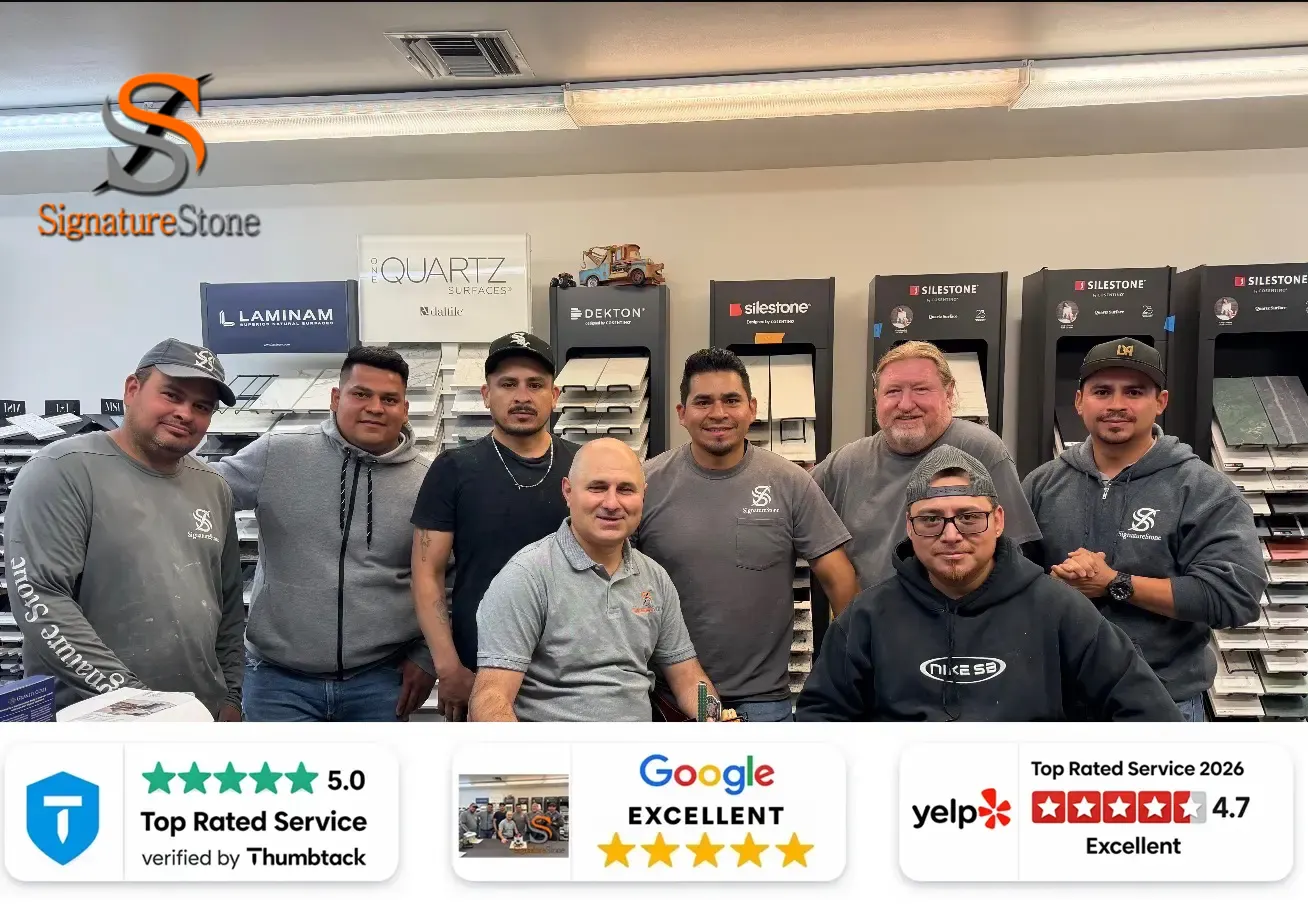
Free Estimate
Core Differences: Quartz, Granite, and Quartzite Overview
Quartz, granite, and quartzite represent three distinct countertop materials with different origins, compositions, and characteristics. Understanding whether you’re choosing engineered quartz or natural stone countertops affects everything from maintenance requirements to heat resistance in your Las Vegas kitchen.
What Is Quartz?
Quartz countertops are engineered surfaces made from approximately 90-93% ground natural quartz crystals combined with resins, polymers, and pigments. The manufacturing process binds these materials under intense heat and pressure to create non-porous slabs.
You get a consistent appearance because manufacturers control the color and pattern during production. This engineered approach eliminates the natural variations found in quarried stone.
The resin binders make quartz less heat-resistant than natural alternatives. You should avoid placing hot pots directly on the surface, as temperatures above 300°F can damage the resin and cause discoloration or cracking.
Key characteristics of engineered quartz:
- Non-porous surface resists staining without sealing
- Available in consistent colors and patterns
- Contains approximately 7-10% resins and pigments
- Manufactured in controlled factory settings
What Is Granite?
Granite countertops are 100% natural igneous rock formed from cooled molten magma deep within the earth. The stone contains primarily quartz and feldspar minerals, along with mica and other trace elements that create unique color variations.
Each granite slab differs in appearance because natural formation processes determine the mineral composition and pattern. The cooling rate of magma affects color intensity—quartz content creates translucent areas while feldspar produces pink or white tones.
Granite withstands high heat without damage, making it suitable for placing hot cookware directly on the surface. The stone’s natural porosity requires periodic sealing to prevent staining and bacterial growth.
You’ll find granite available in thickness options ranging from ¾-inch to 1¼-inch. The thicker slabs typically cost more but provide additional durability and a more substantial appearance.
What Is Quartzite?
Quartzite countertops come from natural metamorphic rock that begins as sandstone and transforms under extreme heat and pressure within the earth. This process creates a material where quartz grains fuse together rather than simply bonding.
The stone ranks 7-8 on the Mohs hardness scale, making it harder than granite and more resistant to scratching. Quartzite naturally occurs in white or gray, but mineral impurities during formation can produce yellow, blue, green, brown, or orange hues.
You get a marble-like appearance with superior durability compared to actual marble. The stone resists UV damage, making it appropriate for kitchens with significant sun exposure in Las Vegas homes.
Quartzite requires sealing because its natural composition includes microscopic pores. You’ll need to reseal the surface every 1-2 years depending on usage and the specific stone’s porosity level.
Engineered vs. Natural Stone Countertops
Engineered quartz offers uniformity and minimal maintenance but contains synthetic binders that limit heat resistance. Natural stone countertops (granite and quartzite) provide authentic geological patterns with superior heat tolerance.
Manufacturing differences create distinct performance characteristics:
| Feature | Engineered Quartz | Natural Stone |
|---|---|---|
| Composition | 90-93% quartz + resins | 100% natural rock |
| Pattern consistency | Uniform and predictable | Unique variations |
| Sealing requirements | Never needed | Required periodically |
| Heat resistance | Moderate (up to 300°F) | High (500°F+) |
| Porosity | Non-porous | Naturally porous |
Natural stone countertops require quarrying, cutting, and polishing of actual rock formations. Engineered quartz uses crushed stone waste combined with binding agents, creating a more consistent product with controlled properties.
You sacrifice some natural aesthetics with quartz but gain stain resistance without maintenance. Natural options demand more care but handle heat better and provide authentic stone character that varies from slab to slab.
Comparative Analysis: Durability, Maintenance, and Performance
Quartz, granite, and quartzite each deliver distinct performance characteristics in terms of physical resistance, porosity, and upkeep requirements. Understanding how these materials handle daily kitchen challenges helps you select the right surface for your Las Vegas home.
Scratch and Heat Resistance
Quartzite ranks highest on the Mohs hardness scale at 7-8, making it the most scratch-resistant option. Granite follows closely at 6-7, while quartz matches quartzite’s hardness rating of 7-8 despite being engineered.
Heat resistance favors natural stones. Both granite and quartzite withstand direct contact with hot pots and pans without damage. Quartz contains resin binders that can scorch or discolor when exposed to temperatures above 300°F.
For Las Vegas kitchens where cooking frequently involves high heat, granite and quartzite provide better thermal protection. Quartz requires trivets or hot pads for all heated cookware.
Stain Resistance and Porosity
Quartz offers superior stain resistance due to its non-porous engineered surface. No sealing is required, and spills from wine, coffee, or oil wipe away without penetrating the material.
Granite has medium porosity and requires periodic sealing to prevent staining. Unsealed granite can absorb liquids, leading to discoloration over time. Quartzite has low to medium porosity, offering better natural stain resistance than granite but still benefits from sealing.
Porosity Comparison:
| Material | Porosity Level | Sealing Required |
|---|---|---|
| Quartz | Non-porous | No |
| Quartzite | Low to Medium | Yes (less frequent) |
| Granite | Medium | Yes (periodic) |
Care and Maintenance Requirements
Quartz demands the least maintenance with no sealing necessary. Clean with mild soap and water, avoiding abrasive cleaners or bleach that can dull the surface.
Granite requires sealing every 1-2 years depending on use and the specific stone type. Daily cleaning involves pH-neutral cleaners designed for natural stone. Acidic substances like lemon juice should be wiped immediately.
Quartzite needs sealing but less frequently than granite due to lower porosity. Use the same gentle cleaning approach as granite. Both natural stones benefit from periodic professional resealing to maintain optimal protection.
Longevity and Resale Value
All three materials deliver decades of service when properly maintained. Granite and quartzite can last 50+ years, while quartz typically performs well for 25-30 years before showing wear.
Resale value remains strong for all options in Las Vegas homes. Granite appeals to buyers seeking natural stone character. Quartzite attracts premium buyers due to its marble-like appearance and superior durability. Quartz resonates with buyers prioritizing low maintenance.
Natural stone variations make granite and quartzite countertops unique, which some buyers view as adding property value. Quartz offers consistency that appeals to contemporary design preferences in newer Las Vegas developments.
Aesthetic Appeal and Customization Options
Quartz, granite, quartzite, and Dekton each deliver distinct visual characteristics that influence your kitchen’s overall design. Your selection between these materials depends on the specific color palette, pattern consistency, and finishing details you want in your Las Vegas home.
Colors, Patterns, and Visual Consistency
Quartz offers the most predictable appearance because manufacturers control the production process. You’ll find uniform patterns across slabs, making it easier to visualize your finished kitchen. Popular options include white bases with delicate gray veining that mimic Carrara marble, plus solid colors ranging from pure white to charcoal.
Granite provides natural variation with every slab unique. Each piece features different mineral deposits, flecks, and movement patterns. Common granite colors include speckled blacks, warm browns with gold veining, and cool grays with blue undertones.
Quartzite delivers marble-like elegance with subtle veining in whites and grays. The natural stone shows more consistency than granite but less uniformity than quartz. Expect gentle variation between slabs from the same quarry.
Dekton combines engineered precision with bold design options. You can select ultra-realistic marble lookalikes, industrial concrete finishes, or solid contemporary colors that maintain their appearance under intense Las Vegas sunlight.
Edge Profiles and Surface Finishes
Your edge profile shapes how light interacts with the countertop and affects the overall kitchen design. Standard options include:
- Straight/Square: Clean, modern lines
- Eased: Slightly rounded for safety
- Bullnose: Fully rounded edge
- Beveled: Angled cut at 45 degrees
- Waterfall: Extends vertically to the floor
Quartz and Dekton handle intricate edge work better than natural stone because they’re engineered without natural fissures. Granite and quartzite typically limit you to simpler profiles to prevent chipping.
Surface finishes alter both appearance and maintenance. Polished surfaces reflect light and intensify colors but show fingerprints. Honed (matte) finishes hide smudges and offer a softer look. Leathered textures add dimension while masking water spots.
Popular Brands: Caesarstone and Silestone
Caesarstone specializes in quartz with premium aesthetic options. Their Statuario Nuvo mimics Calacatta marble with bold gray veining on white backgrounds. The brand offers both polished and concrete-style finishes.
Silestone manufactures quartz surfaces with proprietary antibacterial protection. Their Eternal Collection replicates natural marble patterns, while the Loft series delivers industrial looks. Silestone introduced Hybriq technology using recycled materials without compromising visual quality.
Both brands provide consistent color matching across multiple slabs, which matters when you need seams in larger Las Vegas kitchen layouts. They offer similar edge profile capabilities and typically cost within the same price range.
Cost Factors and Installation Considerations in Las Vegas
Countertop pricing in Las Vegas reflects both national material costs and local market conditions, with installation typically running between $40 and $250 per square foot depending on your choice of stone. Desert climate conditions and supplier networks specific to Nevada impact both availability and final pricing for kitchen countertops.
Material and Installation Costs
Quartz countertops cost $40 to $200 per square foot installed in Las Vegas, with most projects averaging $88 per square foot. Brands like Caesarstone, Silestone, and Cambria dominate the local market and offer consistent pricing across fabricators.
Granite runs $40 to $200 per square foot installed, though mid-range slabs typically fall between $80 and $140. Common varieties like Uba Tuba and Santa Cecilia sit at the lower end, while exotic blues and greens push toward premium pricing.
Quartzite countertops cost $50 to $200 per square foot installed. The material commands higher prices than granite due to its rarity and the specialized fabrication equipment required to cut and polish the harder stone.
Labor accounts for 30% to 40% of your total project cost. Las Vegas installation rates run $20 to $50 per square foot, with experienced stone fabricators charging toward the higher end for complex layouts or premium materials.
Availability and Sourcing in the Local Market
Las Vegas has multiple wholesale stone yards and fabricators that stock quartz and granite inventory year-round. Cambria, Caesarstone, and other major quartz manufacturers maintain strong distribution networks in Nevada, making engineered stone readily available with minimal lead times.
Granite availability depends on slab origin and color. Common varieties ship quickly from domestic distributors, while exotic patterns imported from Brazil, India, or Norway may require 4 to 8 weeks for delivery.
Quartzite is less commonly stocked than quartz or granite in Las Vegas warehouses. You’ll find popular varieties like Sea Pearl and Taj Mahal available, but rare patterns often require special orders. This limited local inventory can extend project timelines by several weeks.
Most fabricators require you to visit their showroom to select your specific slab, particularly for natural stone where veining and color vary between pieces.
Factors Affecting Price: Thickness, Brand, and Customization
Standard countertop materials come in 2cm or 3cm thickness. The 3cm slabs cost 20% to 40% more but eliminate the need for plywood backing and create a more substantial appearance.
Brand selection significantly impacts quartz pricing. Premium brands like Cambria run $20 to $40 per square foot higher than value-oriented options, though all engineered quartz offers similar durability regardless of manufacturer.
Edge profiles add $10 to $40 per linear foot beyond basic eased edges. Ogee, bullnose, and waterfall edges require additional fabrication time and material waste.
Cutouts for undermount sinks cost $150 to $300 each due to the precision cutting and edge polishing required. Cooktop openings and faucet holes add $50 to $150 per cutout. Each customization increases both material waste and fabrication hours, directly raising your total project cost.
Beyond the Big Three: What Is Dekton? Ultra-Compact Surfaces Explained
Dekton represents a distinct category of countertop material that uses extreme pressure and heat to compress mineral particles into a non-porous slab. This engineered surface offers specific performance advantages for Las Vegas kitchens, particularly in heat resistance and UV stability, though it comes with trade-offs in cost and fabrication requirements.
Dekton Composition and Manufacturing Process
Dekton countertops consist of more than 20 different minerals, including glass, porcelain, and quartz particles. The manufacturing process uses TSP (Sinterized Particle Technology), which applies 25,000 tons of uniform pressure while subjecting the material to extreme temperatures.
This ultracompaction process eliminates micro-defects and creates zero porosity in the final slab. The pressure applied equals approximately 2.5 times the weight of the Eiffel Tower, resulting in a dense, uniform surface throughout.
The material requires no resins or binders like quartz countertops. Instead, the minerals fuse together under heat and pressure, similar to natural stone formation but accelerated and controlled in a manufacturing environment.
Advantages and Limitations Compared to Quartz, Granite, and Quartzite
- Heat resistance: You can place hot pots directly on the surface without damage, surpassing quartz’s heat tolerance
- UV stability: The color remains unchanged in outdoor applications or sun-exposed areas, unlike quartz which can fade
- Scratch resistance: The surface withstands scratching better than standard porcelain and comparable to quartzite
- Stain resistance: The zero-porosity surface repels stains without requiring sealing like granite
Dekton limitations:
- Higher material and installation costs than quartz or granite
- Requires specialized cutting tools and fabrication expertise
- Chips are more difficult to repair than quartz or granite damage
- Limited supplier and fabricator availability compared to mainstream materials
Dekton for Indoor and Outdoor Las Vegas Kitchens
Las Vegas’s intense UV exposure and temperature fluctuations make Dekton countertops particularly suitable for outdoor kitchen applications. The material maintains its color and structural integrity despite constant sun exposure, which would damage quartz surfaces.
For indoor kitchens, Dekton performs well in Las Vegas’s dry climate without requiring the humidity considerations that affect some natural stones. The A1 fire-resistance certification provides safety in cooking areas, and the low thermal expansion coefficient handles the temperature variations between air-conditioned interiors and hot outdoor air.
Dekton slabs come in sizes up to 3200 x 1440 mm, allowing for minimal seams in large kitchen layouts. You can select from thicknesses of 4mm, 8mm, 12mm, 20mm, or 30mm depending on your application needs and budget constraints.
Making the Right Choice: Selecting the Best Countertop for Your Kitchen
Your decision should balance how you live in your kitchen, the look you want to achieve, and the long-term impact of your material choice. Las Vegas homes face unique conditions that make certain materials more practical than others.
Lifestyle and Usage Needs
Your daily kitchen habits determine which material will perform best. If you cook frequently with hot pans and prep meals directly on counters, granite and quartzite offer superior heat resistance compared to quartz, which can discolor under extreme heat. Quartz never needs sealing and resists stains from wine, coffee, and acidic foods, making it ideal for busy households that prioritize quick cleanup.
Quartzite requires periodic sealing like granite but offers exceptional hardness. It scratches less easily than granite while maintaining the natural stone appearance many homeowners prefer. If you have children or entertain often, quartz provides the most forgiving surface for spills and impacts.
Las Vegas’s dry climate means sealed surfaces like granite and quartzite may need resealing less frequently than in humid regions. Consider your willingness to maintain your countertops when comparing quartzite vs quartz vs granite. Quartz eliminates maintenance tasks entirely, while granite and quartzite need attention every 1-2 years depending on use.
Visual Style and Home Value
Natural stone patterns in granite and quartzite create unique variations that engineered quartz cannot fully replicate. Each granite or quartzite slab features distinct veining and color movement, giving your kitchen a one-of-a-kind appearance. Quartz offers consistent patterns and a wider range of colors, including solid hues and marble-like designs that suit contemporary aesthetics.
For resale value in Las Vegas homes, all three materials appeal to buyers, but granite remains the most recognized premium option. Quartzite commands similar respect while offering rarity. Quartz appeals to buyers seeking modern, low-maintenance solutions.
Your existing cabinetry and flooring should guide your material selection. Lighter quartz works well with dark cabinets, while dramatic granite or quartzite veining can serve as a focal point in neutral kitchens.
Environmental and Sustainability Considerations
Quartzite and granite are natural stones extracted through quarrying, which involves significant land disruption and transportation energy. Quartz countertops contain 90-95% ground natural quartz bound with resins and pigments, making them engineered rather than purely natural. This manufacturing process requires less quarrying but involves industrial production.
Local sourcing reduces environmental impact. Some granite comes from domestic quarries, while most quartzite travels longer distances. Quartz manufacturing occurs in controlled facilities, potentially offering better quality control but higher energy use during production.
Durability matters for sustainability. All three materials last decades when properly maintained, avoiding landfill waste from replacements. Quartz’s lack of sealing requirements means fewer chemical treatments over its lifetime. Granite and quartzite sealed with low-VOC products minimize indoor air quality concerns while protecting your investment.
Frequently Asked Questions
Homeowners evaluating countertop options need clear answers about durability differences, heat performance comparisons, material composition, and cost considerations specific to desert climates like Las Vegas.
What are the key differences in durability, maintenance, and appearance between quartz, granite, and quartzite countertops?
Granite offers natural hardness and scratch resistance, while quartzite resists etching from acidic substances better than granite. Quartz engineered surfaces provide superior resistance to stains, scratches, and etching compared to both natural stone options.
Maintenance requirements vary significantly between these materials. You need to seal granite and quartzite regularly to maintain their stain and water resistance. Quartz countertops never require sealing because they’re non-porous.
Granite displays natural variations in color and pattern, meaning each slab is unique. Quartzite typically appears in lighter shades like creamy-white and pale gray with marble-like veining. Quartz countertops offer consistent patterns and are manufactured in both solid colors and natural stone replications.
How does Dekton compare to quartz in heat resistance, scratch resistance, and stain resistance?
Dekton handles extreme heat better than quartz, allowing you to place hot pans directly on the surface without damage. Quartz can discolor or crack when exposed to temperatures above 300°F, making trivets necessary for hot cookware.
Both materials resist scratches exceptionally well during everyday use. Dekton’s ultra-compact structure makes it slightly harder than quartz, though both perform well under normal kitchen conditions.
Dekton and quartz are both non-porous, providing equal stain resistance without requiring sealants. You can clean both surfaces with mild soap and water.
What are the most common disadvantages of Dekton countertops in real-world kitchen use?
Dekton costs more than quartz, granite, and quartzite, making it the most expensive option for most kitchen projects. The price difference can be substantial enough to affect your overall renovation budget.
Installation complexity increases with Dekton due to its density and weight. You need experienced fabricators with specialized equipment, and mistakes during fabrication are costly because the material cannot be repaired easily.
Dekton’s appearance remains consistent across slabs, which some homeowners view as less visually interesting than natural stone. The limited selection of patterns and colors may not match every design preference.
How do countertop costs typically compare among Dekton, quartz, granite, and quartzite in Las Vegas?
Granite typically costs the least among these materials, making it the most budget-friendly premium countertop option. Prices vary based on color rarity and pattern complexity, but standard granite remains economical.
Quartz falls in the middle price range, offering predictable costs without the price variations common in natural stone. Quartzite sits at the higher end of the spectrum due to its rarity and the difficulty of quarrying and fabricating it.
Dekton commands premium pricing above all three alternatives. Your total investment increases further when you factor in specialized installation requirements and the need for experienced fabricators.
Is Dekton a type of quartz, and what is it made of?
Dekton is not quartz. It’s an ultra-compact surface made from a blend of raw materials including porcelain, glass, and quartz particles.
The manufacturing process subjects these materials to extreme heat and pressure through a technology called particle sintering. This creates a product that’s distinct from engineered quartz countertops, which use approximately 90% crushed quartz bound with polymer resins.
Which countertop material performs best for Las Vegas homes considering heat, sun exposure, and everyday kitchen wear?
Dekton handles Las Vegas heat and intense sun exposure better than any alternative. Its UV resistance prevents fading, and its heat tolerance accommodates the extreme temperatures common in desert climates.
Granite performs well in hot climates, offering natural heat resistance and durability against temperature fluctuations. It won’t fade from sun exposure and can handle hot pans without damage when properly sealed.
Quartz presents challenges in Las Vegas environments because prolonged sun exposure can cause discoloration in some products. You should avoid installing quartz in outdoor kitchens or areas with direct sunlight. For indoor applications with normal kitchen use, quartz delivers excellent performance in stain resistance and requires minimal maintenance.
Quartzite combines heat resistance with UV stability, making it suitable for Las Vegas homes. You need to maintain the sealer to ensure long-term performance against the dry climate.
0 comments